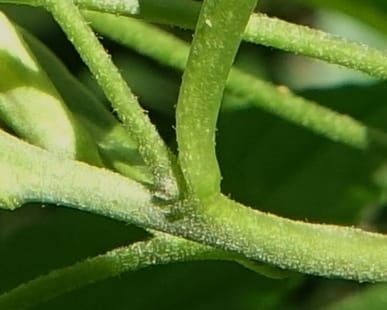
Cestrum parqui, Fortunato 13166--Argentina. S. of San Augustin. Las Bretes. 8 Feb 2018. DSC09370 (33).JPG
Native to Argentina Northeast, Argentina Northwest, Argentina South, Bolivia, Brazil South, Brazil Southeast, Brazil West-Central, Chile Central, Chile North, Chile South, Paraguay, Uruguay; introduced into Baleares, Bangladesh, California, Canary Is., East Himalaya, Florida, Greece, Italy, Jawa, Juan Fernández Is., Kenya, Lebanon-Syria, Lesser Sunda Is., Madeira, Morocco, Mozambique, New South Wales, New Zealand North, Pakistan, Portugal, Queensland, Rwanda, Sicilia, South Australia, Spain, Texas, Tunisia, Victoria, West Himalaya (source: POWO). Flora of the World documents 2 occurrences across 2 countries.
Location
Argentina, San Juan, Valle Fertil (Astica)
-30.934167, -67.308333
Location Remarks
RP 510, 34 kms de Villa San Agustín, a 1 km al W por camino en direcc. al Parque Nat. Dpto. Valle Fértil. 707 m elev.
Collectors
Renée H. Fortunato, W. Douglas Stevens, Olga Martha Montiel, Christopher Davidson, Sharon R. Christoph
Notes
Partial shade along the sandy edges of a dirt track. Shrub c. 2.5 m.
Location
Chile, Maule, Curico (Molina, Chacayes)
-35.451944, -71.031944
Location Remarks
Comuna Molina, Parque Nacional Radal Siete Tazas, 0.4 km below Parque Ingles; roadside along stream. 1095 m elev.
Collectors
W. Douglas Stevens, Christopher Davidson, Sharon R. Christoph, Olga Martha Montiel
Notes
Colonial shrub, shoots 1-1.2 m tall, with a skunky odor, corolla dull yellow, sweetly fragrant, fruits green to purple.
Kingdom
Plantae
Phylum
Tracheophyta
Class
Magnoliopsida
Order
Solanales
Family
Solanaceae
Genus
Cestrum
Specific Epithet
parqui
Authorship
(Lam.) L'Hér.
What is EDGE?
Evolutionary distinctiveness
Lower
ED 0.8
Part of a well-represented branch of the plant tree of life, with many close relatives.
Threat status
IUCN Red List
EDGE score
0.0
Global rank
#310,114 of 335,497
Top 93%
Extinction probability
6%
